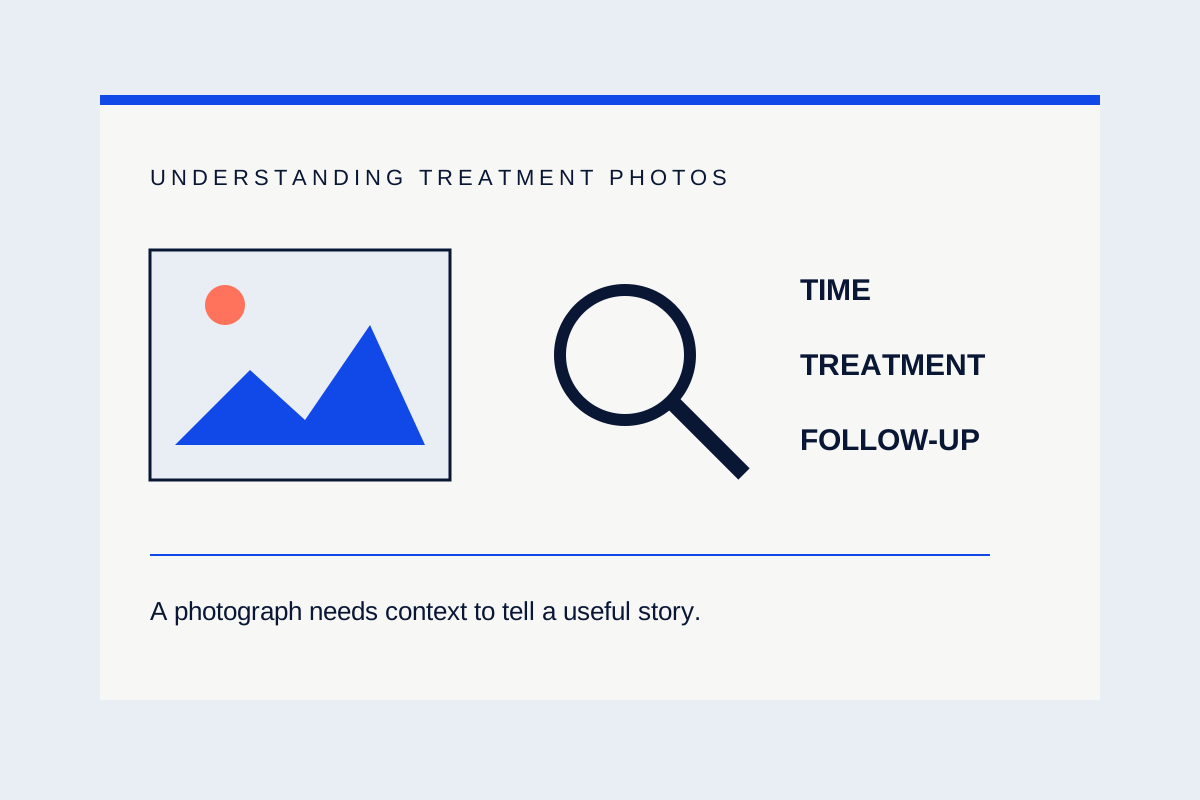
Before-and-after photographs can make a treatment result feel easy to understand. A side-by-side comparison is immediate, and a visible difference may be encouraging. But a photograph tells only part of the story. For a nail concern, the time between images, the treatment used, and the way the result was assessed all matter.
This article explains how to read a nail treatment comparison without expecting a picture to answer every medical question. It is useful whether you are looking at a clinic gallery, discussing a study, or keeping your own record between appointments. The aim is to help you ask for context, understand what is visible, and separate an individual example from a prediction about your own result.
Start with the question the photos can answer
A photo can show how a nail looked at the moment the image was taken. With consistent conditions, it can help illustrate a visible change over time. It cannot provide a complete history, establish the cause of a nail problem, or describe everything the person used between the two images.
Before reading a caption, describe what you can actually see. Is there a change in color, thickness, surface appearance, or the proportion of nail that looks clear? That observation is narrower than saying the person has been cured. Keeping those two statements separate makes the comparison more useful.
You can appreciate a visible improvement without assuming it proves the success of every part of a treatment plan. The next step is to ask what happened between the images and how the clinician evaluated the result. A good comparison gives you a starting point for questions, rather than asking you to stop asking them.
Look for the time between images
A caption should explain when the first image was taken and how long afterward the second image was taken. “After treatment” leaves too much unanswered. It might refer to the end of a course, a later follow-up visit, or a point chosen because the photograph looked particularly clear.
Nails change as they grow. The American Academy of Dermatology notes that treatment takes time and that a toenail can continue to show old discoloration even after an infection has cleared. That is why the end of a treatment session and the final appearance of a nail are different checkpoints.
Read the AAD explanation of treatment and nail growth ↗
Ask whether the image represents a planned review point or simply an available photograph. A clear interval helps you understand what you are seeing, but it still does not create a timetable for your own nail. Your clinician should explain what follow-up would make sense for your situation.
Check that the comparison is like for like
The same nail should be shown from a comparable angle and distance. If one photograph shows the whole foot and the other shows only a small clear area, the comparison may be hard to interpret. Look for enough surrounding detail to understand which nail and which part of it you are viewing.
Lighting can change how color and texture appear. A bright reflection, deep shadow, or strong color cast can make two images look more different than they would under similar conditions. A useful comparison aims for consistent lighting without editing away visible nail features.
Trimming, polish, and changes in the amount of nail shown also deserve context. A tidier presentation can be meaningful for appearance, but it is not the same measurement as infection clearance. Ask what changed in the photograph itself and what changed in the treatment outcome.
Three checks before interpreting a photo
- Same nail
- Comparable lighting
- A stated time interval
Ask what treatment was actually used
If a comparison is presented alongside information about laser, ask whether the person had laser alone or a broader plan. Topical medication, oral medication, nail care, and other interventions may have been involved. Without that history, the photo cannot show which part of the plan contributed to the change.
The same question applies to a medicine advertisement or a social media post about a home routine. A picture of improvement does not isolate a cause. Ask for the treatment description that belongs to the case rather than assuming the product or procedure mentioned nearest the image explains the entire outcome.
A useful caption can be brief and still be specific. It can name the treatment type, note any additional treatment, and state the interval. If those facts are missing, treat the image as an incomplete example and ask for the missing context before using it to compare options.
Appearance and fungal testing are different measures
A clearer-looking nail and a negative fungal test describe different things. Research may assess visible involvement, test results, or both. When a clinic discusses “success,” ask which measure it means. A positive-sounding word should not stand in for a clear explanation.
A review by Gupta and colleagues of randomized laser trials distinguishes clinical and mycological outcomes and reports limited evidence for laser alone. It also notes that none of its included studies reported complete cure. That context is useful when a photograph is used alongside a broad treatment claim.
Read the review of laser treatment outcomes ↗
If a caption says “clear,” ask whether it describes appearance or laboratory testing. If it says “complete cure,” ask what criteria were used. You do not need to know the terminology in advance. A clinician should be able to explain the difference without expecting you to interpret a research paper alone.
Understand what one person's result cannot predict
An individual result can be real and still be a poor predictor for someone else. Two people may have different diagnoses, different starting points, or different treatment histories. The value of a photograph is that it illustrates one case. It does not tell you how often that result occurs.
A gallery usually contains selected examples rather than every person who had treatment. It does not provide a denominator: how many people were assessed, how many were treated, and how many had a similar result. Without that information, you cannot turn the number of attractive photos into a success rate.
Ask how the clinician estimates likely benefit for you. The answer may involve evidence, the diagnosis, your history, and the proposed plan. A responsible explanation can acknowledge uncertainty. An impressive image should support that conversation, not replace it.
Keep longer-term follow-up in view
The most dramatic image is not necessarily the latest one. Ask whether there was follow-up after the displayed comparison and whether the result was maintained. If the caption does not say, do not assume that no further care was needed.
Cochrane's review found low-quality evidence suggesting little or no difference in mycological cure between laser and no treatment or sham treatment in three trials. Complete cure was not measured in those comparisons. A positive individual photograph does not resolve that uncertainty about overall effectiveness.
Read the Cochrane review of device-based treatment ↗
When discussing your own plan, ask when reassessment will occur and what would count as meaningful benefit. If a proposed plan has no review point, it is harder to know when to continue, change course, or revisit the diagnosis. A photo record is most useful when it belongs to an agreed follow-up plan.
A photo is one part of the picture
- Appearance
- Treatment history
- Clinical follow-up
Use your own photographs as a record
If your clinician recommends keeping photographs, choose a simple approach you can repeat. Use the same general position, a similar distance, and ordinary consistent lighting. Keep the original files and the dates. You are making a record for comparison, not trying to create a polished advertisement.
Try not to change several things between images just to make the later one look better. Avoid filters or retouching. If the nail was trimmed, polish removed, or a product used around the time of a photo, mention that when discussing it. Context is more valuable than a perfectly styled image.
Ask how often photographs would be useful. Taking them constantly may produce lots of slightly different images without helping the next appointment. An agreed schedule makes the record easier to review and keeps the focus on the clinical plan rather than on judging tiny daily changes.
Keep private records separate from public images
A photograph you bring to a consultation is not automatically something you want displayed on a public website. If you are asked about sharing a treatment image, take time to understand where it would appear and what caption would accompany it. You should be comfortable with the proposed use.
For your own records, avoid including unnecessary personal details in the picture. A paper label with a full name, a visible document, or a reflection in the background may reveal more than the nail itself. When sharing an image with a clinic, use the method the clinic recommends.
If you are looking at a public case example, expect the relevant treatment context rather than personal identifiers. The useful information is the starting concern, what care was involved, and when the result was assessed. A person's name or face is generally not needed to understand a nail comparison.
Questions to bring to a consultation
Ask whether your diagnosis and starting point resemble the case being shown. Ask which treatments were used, how long the interval was, and whether fungal testing formed part of the assessment. Then ask what the image cannot tell you about the proposed plan for your own nail.
It can help to put your questions in a short sequence: what changed, what was done, how was it measured, and what happened next? This keeps the conversation grounded. It also gives the clinician an opportunity to explain why an image is relevant or why another type of evidence may be more useful.
You do not need to be skeptical of every photograph to ask these questions. The aim is to use an example fairly. A well-described image can help you understand a treatment journey, while a clear discussion of limits helps you avoid expecting an identical outcome.
Discuss your goals with My Foot Laser Center
If you are considering care for a nail concern, start with an assessment and explain what you want to improve. Bring any earlier photographs you already have and tell the clinician when they were taken. Ask how appearance, symptoms, and any appropriate tests would be used to evaluate your progress.
My Foot Laser Center has locations in Reseda 91335, Artesia 90701, and Rancho Cucamonga. Office hours vary by location. Call the office to arrange an appointment and confirm the office details for the location you prefer.
The most useful next step is a conversation about your own nail, rather than choosing a treatment from a photo alone. Explore our article on laser research for more context, and use a consultation to ask how the evidence and any case examples relate to your individual concern.
Common questions
Can a before-and-after photo prove that nail fungus is cured?
No. It can show appearance at two points in time. Ask whether the diagnosis and outcome were also assessed clinically or with fungal testing, and what the caption means by improvement.
What should a useful treatment photo caption include?
Look for the treatment used, any additional care, and the time between photographs. The image should show the same nail under comparable conditions and make clear that an individual result is not a guarantee.
Can I expect the same result as someone in a gallery?
An individual photo cannot predict your result. Your diagnosis, starting point, health history, and treatment plan may differ. Ask how the example relates to your circumstances.
Should I bring old nail photos to my consultation?
Bring them if you already have useful images, and explain when they were taken and what treatments you were using. You can still arrange an assessment if you do not have photographs.
General patient education, not a diagnosis or personalized treatment recommendation. Discuss your concerns with a qualified clinician. Educational illustrations do not show patient results.